Blog 2: Placing Africa in time
Welcome back. Africa has a long and rich history that spans hundreds of thousands of years. This blog post is going to provide a brief overview of some of the key events and developments in African history:
Early African history
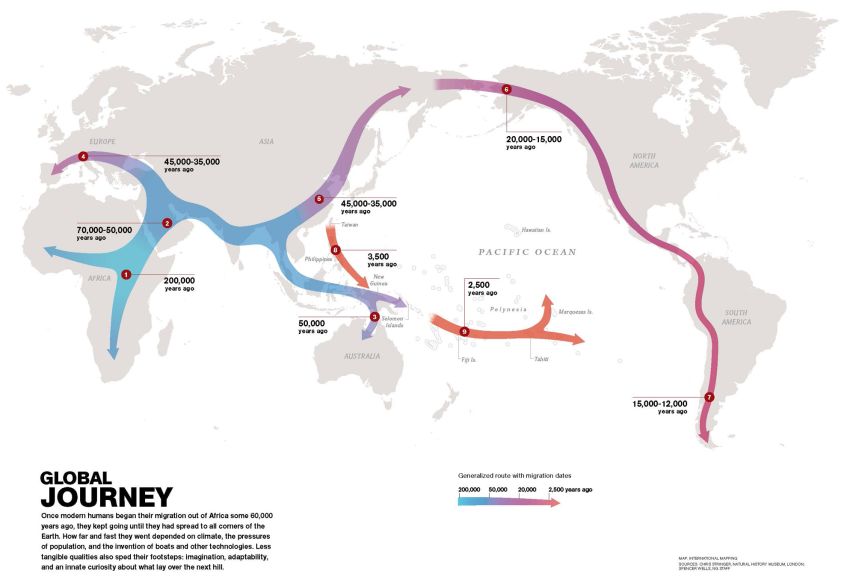
The earliest recorded fossil of the modern human, Homo sapiens, is dated to be around 160,000 to 190,000 years old, and was found in eastern African in Ethiopia. Fast forward to 50,000 to 70,000 years ago and Homo sapiens emigrated out of Africa and over the next 60,000 years spread to every continent on Earth.
Precolonial Africa
The desertification of the Sahara around 8,000 years ago created a natural boundary that split Africa in two. Thus, the history of north Africa became more closely entwined with the Middle East and southern Europe, whilst south African history was largely dominated by the Bantu expansion between 2,000 and 3,000 years ago which created a common linguistic community across much of sub-Saharan Africa.
From the late 5th century to the 15th century Islam spread across much of north Africa, in part driven by the Arab invasions of the 7th century onwards. Elsewhere, many states and societies formed in Africa with notable empires being the Mali empire, Ashanti empire, Ghana empire, and the Great Zimbabwe Empire (see the map below).

A precolonial map showing the African kingdoms and kingdoms from 500 B.C to 1500 A.D - from Hall. S. and Ollimo. M (2018) The Role of Institutions, in Society for Institutional and Organisational Economic 2019 Paper.
The transatlantic slave trade
From the 15th to the 19th centuries, the Europeans engaged in the transatlantic slave trade in which millions of Africans were captured, transported, and sold as slaves in the Americas. The slave trade had a devastating impact on Africa, both economically and socially.
Colonial Africa
In the late 19th and early 20th centuries, Europe partitioned and colonised much of Africa, establishing a number of colonies and protectorates on the continent with the Berlin Conference of 1884 distinguished as the start of this Scramble for Africa. Only Liberia and Ethiopia remained uncolonised. This period of colonialism was marked by exploitation, repression, and conflict, and has and has had a lasting impact on the development of Africa.
The impacts of both the transatlantic slave trade and European colonisation has left both physical and cultural legacies in Africa and across the African diaspora. One of the most recognisable legacies was the formation of nation states by European powers (see the map below and compare it to the map above). The carving up of Africa along very arbitrary border lines now factors into contemporary geopolitical issues within Africa, some of which we will hopefully explore in the next blog.

Post-colonial Africa
The mid-20th century was dominated by the traction of the independence movement in Africa culminating with 1960 being the Year of Africa, when 17 countries gained independence. The 21st century has been characterised by the economic growth of many African economies, greater African cohesion across the continent, urbanisation, and an explosion of African culture to the wider global community. African solidarity is best represented by the launching of the African Union in 2002 with 55 member states comprising the entire continent, as a successor to the Organisation of African Unity (OAU).
Africa and the West: a contentious relationship
Even after the end of colonialism, the West has continued to play a significant role in Africa's development through various forms of aid and assistance. This has included providing financial aid, technical assistance, and development projects aimed at addressing poverty, improving health care and education, and promoting economic growth.
In recent years, the West has also been involved in Africa through trade, investment, and economic partnerships. Many Western companies have invested in Africa, and the continent has become an important market for Western exports. However, some critics argue that these economic interactions have not always benefited Africa and have sometimes contributed to economic inequality and exploitation in the form of neocolonialism.


Comments
Post a Comment